
Zero Down Payment Condos in Manila: How OFWs & First-Time Buyers Qualify
Zero Down Payment Condos in Manila: How OFWs & First-Time Buyers Qualify
By MSC Editorial — the in-house editorial team of Manila Skyline Condos, tracking developer financing promos, Pag-IBIG program updates, and live condo inventory across the Philippines.
"Zero down payment" in Manila's condo market almost never means the developer waives your equity outright — it means the required 5–10% equity is spread into small monthly installments during construction, with nothing due in a lump sum at reservation. OFWs and Pag-IBIG-eligible buyers with clean documents qualify fastest.
That distinction matters because "zero down" gets advertised more loosely than it should. This guide covers the buyer side of that promise: who actually qualifies for a zero-equity-upfront path, what developers are really offering when they market it, how Pag-IBIG's loan-to-value rules interact with a promo like this, and what OFWs and first-time buyers need to have ready before they apply. It does not walk through the reservation-fee-to-turnover payment ladder itself — that mechanical breakdown lives in a separate guide, What "Zero Down" Really Means: The Condo Payment Schedule Explained, once it's live. This piece is about eligibility and access, not the installment math.
Key Takeaways
- "Zero down" is marketing shorthand, not a waived fee. It almost always means the developer spreads your required equity into small monthly installments during construction rather than collecting it as a lump sum.
- Pag-IBIG's loan-to-value rules set the real ceiling. Properties under ₱2.5 million can finance up to 95%; ₱2.5 million and above cap at 90% — the remaining 5–10% is the equity a zero-down promo is built to cover gradually.
- OFWs qualify through the same gates as any Pag-IBIG borrower — 24 monthly contributions, active membership, and documents that can be processed through a Special Power of Attorney from abroad.
- Developer promos vary by project, unit, and timing. A studio at one pre-selling tower and a 2BR at another can carry different equity terms even within the same month.
- Pre-selling is what makes zero-equity-upfront possible at all. A ready-for-occupancy unit rarely offers this; the construction period is the window developers use to collect equity in installments instead of one payment.
- The payment schedule's mechanics are a separate topic. This guide covers who qualifies and how to prepare; the reservation-to-turnover breakdown is covered in its own guide.
Quick orientation: If you already know you want the payment-schedule breakdown — reservation fee, equity installments, balloon or turnover payment — that lives in a separate guide once published. This one is about who gets approved for a zero-down path and what you need to prepare.
What Does "Zero Down" Actually Mean for a Manila Condo Buyer?
Start with what the phrase is not. No accredited Philippine developer is legally forfeiting the equity requirement tied to a unit's price — Pag-IBIG's loan-to-value ceiling (90% or 95%, depending on the property's value) is a lender rule, not a developer courtesy, and it doesn't disappear because a sales flyer says "zero down." What a developer can control is how and when that equity gets collected from you.
During pre-selling, a developer builds a tower over roughly 24 to 48 months. That construction window is unpaid time from the bank's perspective — no mortgage exists yet, because there's no completed title to lend against. Developers use that same window to collect your equity contribution in small monthly amounts instead of one payment at signing. When a promo is marketed as "zero down," it almost always means the reservation fee is waived or minimized and the equity requirement is folded entirely into those construction-period installments, so nothing large is due on day one.
That's a real, useful thing for a buyer without ₱200,000–₱600,000 in liquid savings sitting around. It is not the same as the developer eating the cost. You are still paying the equity — just on a schedule that matches your monthly cash flow instead of your bank balance today.
The developer isn't waiving your equity. It's rescheduling when you pay it.
Who Actually Qualifies for a Zero-Down Path?
Three buyer profiles consistently get approved for these promos, and the pattern isn't random — it tracks directly to who a developer's in-house credit desk and Pag-IBIG can process quickly.
Buyers with a documented, verifiable income. Whether that's a Philippine payslip, an OFW employment contract, or a Certificate of Employment from abroad, the single biggest factor in approval speed is whether your income can be verified on paper within days, not weeks. A zero-down promo still runs a credit check — it just removes the upfront cash barrier, not the underwriting.
OFWs with active Pag-IBIG membership. An OFW who has kept their Pag-IBIG contributions current, or can close a contribution gap with a lump-sum catch-up payment, walks into the process already halfway qualified. The Pag-IBIG eligibility guide covers the exact thresholds — 24 monthly contributions, no outstanding arrears, and legal capacity to own property in the Philippines.
First-time buyers without an existing mortgage or Pag-IBIG loan. A clean credit file — no prior cancelled or foreclosed housing loan — clears one of Pag-IBIG's five hard eligibility gates automatically. First-time buyers often qualify faster than repeat buyers precisely because there's nothing on record to review.
Who tends to get slowed down: buyers with informal or undocumented income, buyers with an existing unresolved loan on their credit file, and buyers who haven't yet started their Pag-IBIG contribution count. None of these are disqualifying forever — they're a documentation and timing problem, and the section below on preparation covers how to close each gap. If your situation is a foreign buyer rather than an OFW or a local first-time buyer, the eligibility path is different — start with whether foreigners can buy a condo in the Philippines before layering a zero-down promo on top of ownership basics.
How Do Developer Promos Turn Into a Real Zero-Down Path?
Developer promos are not uniform, and this is where a lot of buyers get confused by marketing language that sounds identical across very different offers. Three structures show up repeatedly across Metro Manila and Bulacan pre-selling launches:
- Waived reservation fee. Instead of the usual ₱20,000–₱50,000 reservation payment due at signing, the developer defers or discounts it, often as a limited-time launch incentive tied to a specific tower phase.
- Extended equity term. Instead of collecting the 5–10% equity over 12–24 months, the developer stretches it to 36–60 months, which lowers the monthly amount enough that it reads as "no down payment" even though the total equity owed hasn't changed.
- Equity-in-monthly-amortization bundling. Some promos fold the equity payment into what looks like a single monthly figure alongside the eventual Pag-IBIG or bank amortization estimate, which is the marketing version most likely to blur into "zero down" language without being technically accurate.
All three structures depend on the same underlying mechanic covered in the broader pre-selling condos in Manila guide — the construction period functioning as an interest-free equity-building window rather than dead time. Zero down is really just an aggressive version of that same pre-selling logic, marketed to remove the last visible barrier: cash on day one.
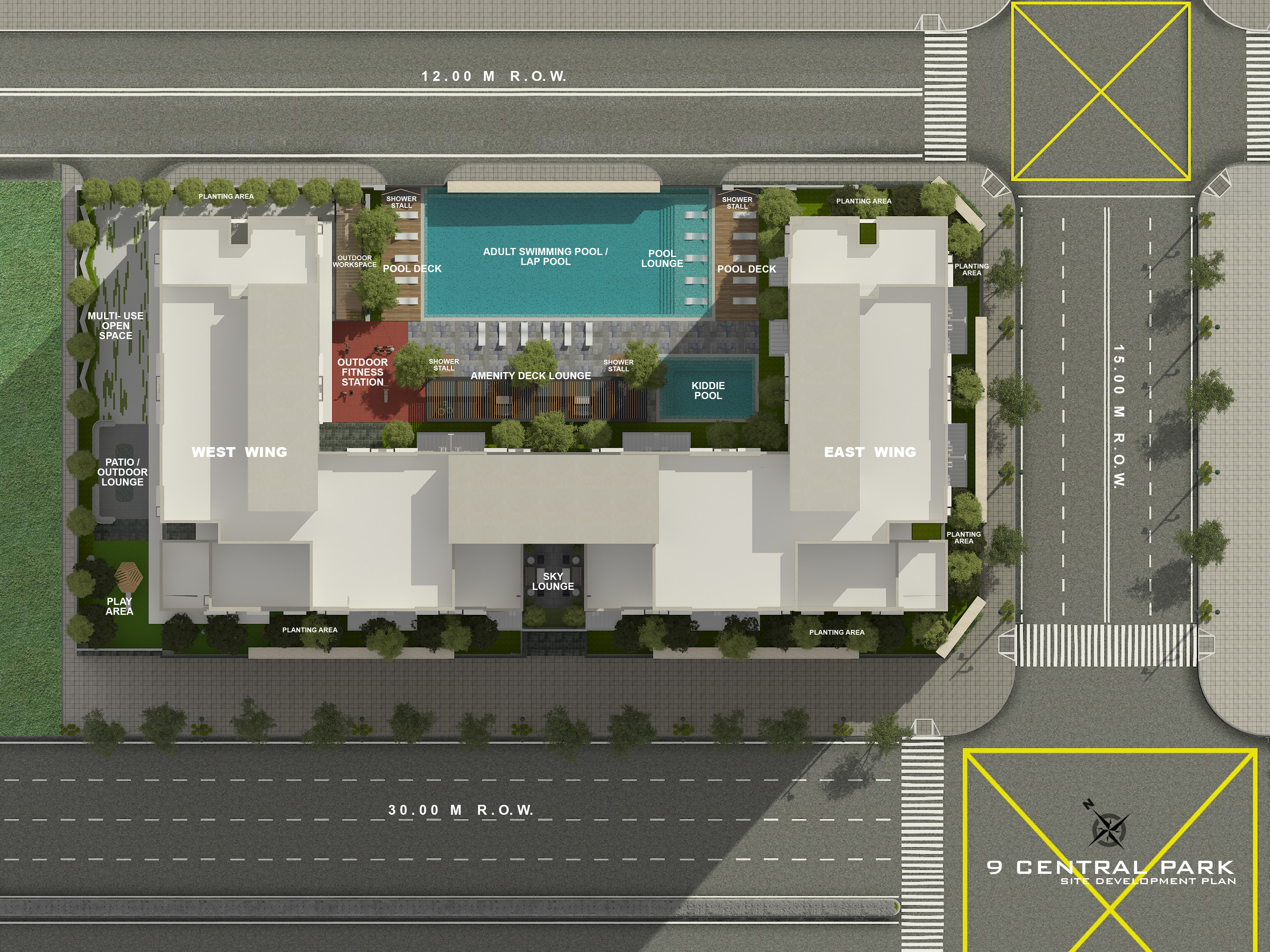
9 Central Park in Northwin Global City, Bulacan is a useful illustration of the pattern without being the only one: Megaworld has marketed reservation and equity terms there starting from roughly ₱10,000 a month during the pre-selling period — a monthly figure low enough that it functions the same way a "zero down" promo does, even when it isn't labeled that way. The mechanism is the same regardless of which tower or which developer runs it: spread the entry cost thin enough that no single payment feels like a barrier.
The honest caution here: a promo that looks identical to another buyer's deal may not be identical to yours. Unit type, floor level, and how close the project is to its selling launch all move the actual terms. Confirm current terms directly rather than assuming a friend's or a forum post's numbers apply to your unit.
These promos also aren't confined to one corner of Metro Manila. They show up across pre-selling launches in BGC, the Manila Bay Area, and the Bulacan corridor north of the city, because the underlying mechanic — spreading equity across the construction period — works the same way regardless of location. What differs by area is price tier and unit mix, not whether the promo structure exists. In BGC, pre-selling towers like Uptown Modern have run reservation and equity promos with monthly figures published from roughly ₱18,500 for the studio tier — a different price bracket than the North corridor, but the same underlying zero-equity-upfront structure. Manila Bay Area and Makati pre-selling inventory follows the same general promo logic, but because that inventory turns over quickly and terms shift by launch phase, we don't publish specific live prices for those areas here — contact us for what's currently active. The takeaway isn't "go to the cheapest area." It's that the promo structure is portable across the city, and the deciding factor for most buyers ends up being which area's price bracket actually fits their income, not which area has the flashier zero-down headline.
Can Pag-IBIG Loan-to-Value Rules Cover the Rest of the Price?
This is the part that makes zero-equity-upfront mathematically possible rather than just a sales phrase. Pag-IBIG's loan-to-value tiers are fixed by regulation, not by developer generosity:
| Property value | Maximum financing (LTV) | Required equity |
|---|---|---|
| Below ₱2,500,000 | Up to 95% | 5% |
| ₱2,500,000 and above | Up to 90% | 10% |
Source: Pag-IBIG Fund official housing loan program page, cross-checked against the loan-to-value figures used in the Pag-IBIG OFW eligibility guide. Confirm current tiers at pagibigfund.gov.ph before applying — these are the rates the housing loan program publishes, not a developer-specific term.
That 5–10% equity gap is exactly what a zero-down promo is engineered to absorb during construction, so that by the time your unit is ready for turnover and Pag-IBIG releases the mortgage takeout, your required equity has already been paid off in small pieces rather than owed all at once. The loan itself still has to clear Pag-IBIG's ₱10 million ceiling and your personal 35% income-to-amortization cap — a zero-down promo doesn't change either of those numbers, it only changes when you pay the piece that isn't covered by the loan. Running your own gross-income-to-max-loan math before you fall for a specific unit is worth doing early — see the honest math on what a given monthly budget actually buys for the calculation walkthrough.
A zero-down promo doesn't raise your loan ceiling or your income cap. It only changes when the equity portion gets paid.
Worth being direct about one thing: if your target unit is a specific, currently-listed inventory item in Makati or the Manila Bay Area with a live price attached, the terms on that exact unit change often enough that we won't publish a number here that could already be stale. Talk to a specialist and we'll confirm the current terms on the actual unit you're looking at.
Does Zero Down Work for OFWs Applying From Abroad?
Yes, and it's arguably the buyer profile these promos were built around. An OFW doesn't need to be physically present in the Philippines to reserve a unit, sign a Contract to Sell, or process a Pag-IBIG loan application — all three can run through an apostilled or consularized Special Power of Attorney naming a representative in the Philippines.
What makes the OFW case for zero down specifically strong is the timing alignment. A construction-period equity schedule that runs 36 to 60 months lines up naturally with a standard two- or three-year overseas contract cycle, and remittances can be set up to cover the monthly equity the same way they'd cover a mortgage payment later. The full mechanics of routing remittances into a structured payment plan — not the schedule itself, but the OFW-specific logistics of reservation, SPA, and remote signing — are covered in the OFW buying guide.
The one thing zero down doesn't remove for an OFW: the 24-contribution Pag-IBIG membership threshold. That clock doesn't accelerate because a developer waives a reservation fee. If you're not yet at 24 contributions, a zero-down promo buys you time to keep contributing during construction — it doesn't substitute for the contributions themselves. And if Pag-IBIG isn't your best fit — some OFWs qualify for better terms through a bank or a developer's own in-house plan — the trade-offs are laid out in the financing options comparison guide.
What Documents Do You Need Before You Apply?
Preparation is where a zero-down application either moves in days or stalls for months. The document set is largely the same whether you're a local first-time buyer or an OFW, with one additional layer for buyers abroad.
- Valid government ID and, for OFWs, a passport. One primary ID plus one secondary is standard across developer and Pag-IBIG intake.
- Proof of income. Payslips or a Certificate of Employment for locally employed buyers; an employment contract, POEA-approved contract, or employer certification for OFWs.
- Pag-IBIG MID number and contribution record. Pull this from Virtual Pag-IBIG before you apply, not after — a contribution shortfall discovered mid-application is the single most common delay.
- TIN (Tax Identification Number). Required for the loan file; a Philippine-based representative can secure this on your behalf if you don't already have one.
- Special Power of Attorney (OFWs only). Apostilled or consularized, naming your representative, with explicit authority to sign the Contract to Sell and the loan application on your behalf.
- Proof of billing. A utility bill or bank statement in your name — for OFWs, one issued at your host-country address is accepted.
None of this is unique to a zero-down promo — it's the standard document set for any pre-selling reservation backed by eventual Pag-IBIG financing. What a zero-down term changes is that you don't need a large cash reserve sitting in a bank account before you start; you need the paperwork in order instead.
What Are the Catches Buyers Miss With "No Down Payment"?
Every promo has a trade-off somewhere, and the honest version of this guide names them instead of pretending zero down is a free upgrade.
A promo with no catch anywhere is the one worth double-checking hardest.
The total price rarely moves. Zero down changes the timing of your equity payment, not the unit's price. A buyer chasing the promo instead of the underlying value can end up overpaying for a unit that would have been available at a discount with cash equity upfront.
Extended equity terms mean a longer total commitment. Stretching equity from 24 to 60 months is still 60 months of payment obligation before the mortgage phase even starts. A buyer with irregular income — seasonal contract work, project-based OFW deployment — needs to plan for the full stretch, not just the smaller monthly number.
Reservation-fee waivers are often time-boxed. A promo tied to a launch phase can expire, and the terms on the next phase of the same tower may not match. "Zero down" advertised today isn't a guarantee for the unit you reserve six months from now.
The mortgage requirement doesn't disappear. Whatever equity a promo defers, the loan portion still has to clear underwriting when turnover approaches. A buyer who assumes "zero down" means "zero scrutiny" is setting up a bad surprise at the exact moment they're closest to owning the unit. If you want the full reservation-to-turnover breakdown of how a typical payment plan is structured — not just the zero-down variant — the condo payment terms guide walks through it line by line, and a specialist can confirm which structure your target unit actually uses.
How Does Zero Down Compare to a Standard 10–20% Equity Plan?
Laid side by side, the trade-offs are clearer than either version sounds in a sales pitch.
| Factor | Zero-down / low-entry promo | Standard 10–20% equity plan |
|---|---|---|
| Cash needed at reservation | Minimal to none | ₱20,000–₱100,000+ typical reservation fee |
| Monthly equity payment | Lower, spread over a longer term | Higher, spread over a shorter term |
| Total equity owed | Same underlying 5–10% Pag-IBIG-tier requirement | Same underlying 5–10% Pag-IBIG-tier requirement |
| Best fit for | Buyers without a large cash reserve, steady monthly income | Buyers with savings who want a shorter payment runway |
| Risk if income is irregular | Higher — commitment runs longer | Lower — obligation clears faster |
Neither structure is objectively better. A buyer with ₱400,000 sitting in savings and a preference to be done with equity payments in two years is better served by the standard plan. A buyer without that cash reserve, but with a stable monthly income they can commit for four or five years, is the buyer zero-down promos are actually built for.
Zero down is a genuine access point, not a fit for every buyer profile. It's a weaker fit if your income is irregular enough that committing to 36–60 months of steady payments is a real stretch — a shorter, higher-equity plan with a defined end date may suit an unpredictable income better than a long low-monthly commitment. It's also a weaker fit if you're chasing the promo itself rather than the unit — the better exercise is picking the right building and area first, then checking which financing structure fits, not the reverse. It's a strong fit for the buyer this guide has described throughout: documented income, an active or activatable Pag-IBIG membership, and a preference for a smaller, longer monthly commitment over a larger upfront one.
The sequence that actually works: verify your Pag-IBIG contribution count first, gather income documents while that's in progress, and — if you're an OFW — start the SPA process early, since apostille and courier time can run two to four weeks. Only then lock in a specific unit and promo.
Buyers who reserve first and scramble for documents afterward are the ones most likely to lose a promo window. Buyers who prepare the paperwork first and reserve once it's ready are the ones who actually close on the terms they were quoted.
A Transparent Disclaimer
This guide is general information, not financial or legal advice. Pag-IBIG Fund loan-to-value tiers, contribution requirements, and loan ceilings are set by the Home Development Mutual Fund and are subject to change — confirm current figures directly at pagibigfund.gov.ph before applying. Developer promo terms referenced here (reservation fees, equity schedules, monthly entry figures) are general patterns illustrated with real, named projects where publicly available; specific current pricing for Makati and Manila Bay Area inventory is not published in this guide because it changes by launch phase — contact us for current terms on a specific unit. Nothing here should be read as a guarantee of loan approval or promo availability.
About the Author
MSC Editorial is the in-house editorial team behind this guide — the house editorial brand for Manila Skyline Condos. The team researches Philippine condo financing, Pag-IBIG program rules, and developer promo structures using primary government sources and developer-published terms, so buyers get current, source-checked information rather than forum recaps.
Ready to Check What You Actually Qualify For?
If you're weighing a zero-down promo against your income and Pag-IBIG status, talk to a specialist at Manila Skyline Condos. We'll run your numbers against the current terms on the units you're considering — in BGC, the Manila Bay Area, or the Bulacan corridor — and tell you plainly whether the promo you saw actually applies to your situation.
Frequently Asked Questions
Does "zero down payment" mean a developer waives the equity requirement entirely?
No. It means the required 5–10% equity — the same requirement set by Pag-IBIG's loan-to-value rules — gets spread into small monthly installments during construction instead of collected as a lump sum at reservation. The total amount owed generally doesn't change.
Who qualifies for a zero-down condo promo in Manila?
Buyers with verifiable income, OFWs with active or catch-up-eligible Pag-IBIG membership, and first-time buyers with no prior cancelled or foreclosed housing loan tend to qualify fastest. The credit and income checks still apply — a zero-down promo removes the upfront cash barrier, not the underwriting.
Can OFWs apply for a zero-down condo deal from abroad?
Yes. Reservation, the Contract to Sell, and the eventual Pag-IBIG loan application can all be processed through an apostilled or consularized Special Power of Attorney naming a representative in the Philippines, without the OFW needing to be physically present.
Does Pag-IBIG's loan-to-value ratio still apply if a promo says zero down?
Yes. Pag-IBIG finances up to 95% for properties below ₱2.5 million and up to 90% for properties at or above ₱2.5 million. The remaining 5–10% is the equity a zero-down promo is designed to collect gradually — it doesn't raise the loan-to-value ceiling itself.
How many Pag-IBIG contributions do I need before applying for a housing loan?
At least 24 monthly contributions, which do not need to be consecutive. A lump-sum catch-up payment can close a contribution gap. This requirement runs independently of any developer zero-down promo.
Is zero down only available for pre-selling condos?
Effectively yes. The construction period of a pre-selling project is what gives a developer room to collect equity in small installments instead of one payment. Ready-for-occupancy units, where the title already exists and financing must be arranged immediately, rarely offer this structure.
What documents should I prepare before applying for a zero-down promo?
A valid government ID, proof of income (payslips or employment contract), your Pag-IBIG MID number and contribution record, a TIN, and — for OFWs — an apostilled or consularized Special Power of Attorney naming a Philippine representative.
What's the catch with a zero-down condo promo?
The total equity owed generally doesn't change — only the timing does. Extended equity terms mean a longer overall commitment, reservation-fee waivers are often tied to a specific launch phase and can expire, and the mortgage underwriting requirement still applies at turnover regardless of how the equity was collected.
Is a zero-down promo better than paying a standard 10–20% equity plan upfront?
It depends on the buyer. A buyer with savings who wants to finish equity payments quickly is often better served by a standard plan. A buyer without a large cash reserve but with steady monthly income is the profile zero-down promos are built for.
Where in Manila are zero-down or low-entry condo promos currently available?
They appear across BGC, the Manila Bay Area, and the Bulacan corridor north of Metro Manila, since the underlying mechanism — spreading equity across construction — works the same regardless of location. Price tiers differ by area; current specific pricing should be confirmed directly rather than assumed from a general guide.
Sources
Financial and eligibility claims in this article were verified against official and primary sources:
- Pag-IBIG housing loan program — loan-to-value tiers (95%/90%), ₱10M ceiling, 24-contribution eligibility, 35% income rule — Pag-IBIG Fund official: https://www.pagibigfund.gov.ph/availmentofnewloan.html
- Pag-IBIG Fund raises housing loan limit to ₱10 million, 5.75%–9.75% rates, 30-year term — Philippine News Agency: https://www.pna.gov.ph/articles/1275989
- Pag-IBIG Overseas Program — OFW membership and contribution track — Pag-IBIG Fund official: https://www.pagibigfund.gov.ph/pop.html
- Republic Act 9679 (HDMF Law of 2009) — mandatory Pag-IBIG membership — LawPhil: https://lawphil.net/statutes/repacts/ra2009/ra_9679_2009.html
- 9 Central Park — Northwin Global City, Bulacan, pre-selling, monthly terms from ~₱10,000/mo, 478 units — VERIFIED-BUILDING-SPECS.md (cross-checked Megaworld sources, 2026-06-07); Megaworld 9 Central Park: https://www.megaworldcondo.com/9-central-park
- Uptown Modern — Uptown Bonifacio, BGC, pre-selling, monthly amortization from ~₱18,500/mo (studio tier) — VERIFIED-BUILDING-SPECS.md (own-curled megaworldcbd.com/uptown-modern, 2026-07-11)
- Related internal guide (same-site) — full Pag-IBIG OFW eligibility detail — Pag-IBIG Housing Loan for OFWs guide: https://manilaskylinecondos.com/post/pagibig-housing-loan-ofw-eligibility
Note on verification: Pag-IBIG's loan-to-value tiers, ₱10M ceiling, 24-contribution requirement, and 35% income rule are confirmed against the official Pag-IBIG Fund housing loan page and cross-checked with the site's own previously-verified Pag-IBIG OFW eligibility guide. Developer promo figures for 9 Central Park and Uptown Modern are drawn from VERIFIED-BUILDING-SPECS.md, the operator's cross-checked internal source of record; no price or promo figure for Makati or Manila Bay Area inventory is asserted in this guide, since current terms for that inventory were not independently re-verified at time of publication — readers are routed to direct contact for those figures instead.
