
Renting vs Buying in Makati: The Real Break-Even Math for 2026 Buyers
Renting vs Buying in Makati: The Real Break-Even Math for 2026 Buyers
By MSC Editorial — the in-house editorial team of Manila Skyline Condos, tracking Makati rent and purchase costs, break-even timelines, and live condo inventory across the Philippines.
Direct answer: in Makati's CBD-core villages, buying typically breaks even against renting somewhere around year seven to eleven, depending on district and financing terms — later than most buyers assume, and later than it takes in a newer-build BGC-area alternative where the entry price sits lower relative to rent. That single number is the one most "should I rent or buy" articles never actually calculate, preferring vibes over arithmetic. This guide calculates it.
We walk the real math district by district — what renting costs, what buying costs once financing and ownership expenses are added, and the year the two lines cross — then apply it to three buyer profiles so the answer isn't abstract. The goal is not to tell a reader to buy or to rent; it is to give them the actual number their specific situation produces, so the decision is arithmetic, not aspiration.
Key Takeaways
- Break-even in Makati's CBD-core villages (Salcedo, Legazpi) typically lands around year eight to eleven of ownership, once financing costs, dues, and taxes are weighed against rent saved — later than in Poblacion or a comparable BGC-area pre-sell.
- Poblacion breaks even fastest among Makati districts — often year six to eight — because its lower per-sqm entry price shrinks the financing-cost gap against rent.
- Rockwell's break-even runs longest, often past year eleven, because its premium per-sqm pricing means financing costs stay elevated relative to what an equivalent unit would rent for.
- The math changes meaningfully with the down payment size and financing rate — a larger down payment or a Pag-IBIG-eligible rate meaningfully shortens break-even versus a small-down-payment bank loan.
- Renting is the better math for anyone with a horizon under five years in any Makati district — the transaction costs and financing-heavy early years of ownership rarely pay back that fast.
- A BGC-area comparison is worth running before committing — Manila Skyline Condos has live pre-selling inventory at Uptown Modern with a lower relative entry point than Makati's CBD-core villages.
Quick orientation: For Makati's neighborhood picture, see living in Makati 2026; for real monthly costs, see cost of living in Makati. For the first-time buyer angle specifically, see is Makati worth it for first-time buyers, and for the general buy-versus-rent framework, see honest math on buying a Manila condo.
What Does the Rent-vs-Buy Question Actually Compare?
Renting and buying are not the same financial product with a different price tag — they carry structurally different cost profiles, and comparing them honestly means matching the right numbers on both sides. Renting's cost is simple: monthly rent, plus utilities, with no long-term capital commitment and no exposure to a downturn in property values. Buying's cost is more layered: a down payment (opportunity cost on that capital), monthly amortization once financed, association dues, real property tax, and eventually the cost of resale (broker fees, capital gains considerations) if the buyer ever sells — set against the equity the buyer builds with every payment and any appreciation the unit gains over the holding period.
The honest comparison nets these out year by year: total cost of renting versus total cost of owning, minus the equity and appreciation an owner has accumulated by that point. The year those two lines cross is the break-even point — before it, renting wins on pure cost; after it, ownership has paid for itself and continues paying dividends the longer the buyer holds.
Two things this framework deliberately excludes, because they are real but not universally quantifiable across every buyer: the intangible value of stability and control that comes with owning versus the flexibility of a lease, and the tax treatment differences between renting and owning, which vary by individual circumstance and are outside the scope of a general guide. Both matter to a real decision. Neither belongs in a break-even number meant to apply broadly, so this guide isolates the pure financial comparison and leaves those two factors for a reader to weigh on top of the math, not folded into it.
One more clarifying point before the district numbers: this guide's break-even model treats "equity built" conservatively — only the portion of each amortization payment that reduces principal, not the full payment amount — because treating the full payment as equity is the most common error in informal rent-versus-buy comparisons, and it makes ownership look faster to pay off than it actually is in the early years of a loan.
How Much Does Renting Actually Cost in Each Makati District?
The starting point is real 2026 rent data, not a single citywide average. A Poblacion studio or 1-bedroom rents for roughly ₱25,000–₱45,000/month; a Salcedo or Legazpi 1-bedroom, ₱35,000–₱70,000/month; a comparable 2-bedroom in either village, ₱80,000–₱150,000/month; and a Rockwell 1–2-bedroom, ₱70,000–₱200,000+/month. These figures, drawn from Lamudi and Hoppler 2026 listing data, are the denominator every buy-side comparison in this guide is measured against.

| District | Indicative rent (2026) | Indicative buy price / sqm |
|---|---|---|
| Poblacion studio/1BR | ₱25,000–₱45,000/mo | ₱150,000–₱220,000 |
| Salcedo/Legazpi 1BR | ₱35,000–₱70,000/mo | ₱180,000–₱280,000 |
| Salcedo/Legazpi 2BR | ₱80,000–₱150,000/mo | ₱180,000–₱280,000 |
| Rockwell 1–2BR | ₱70,000–₱200,000+/mo | ₱250,000–₱380,000 |
Sources: Lamudi Makati condo listings, Franchise Manila 2026 Makati Condo Rental Yield Report, Hoppler Rockwell listings, cross-referenced against living-in-makati-2026 and cost-of-living-makati-2026 pillar figures. 2026 market estimates — confirm before deciding.
How Much Does Buying Actually Cost Once Financing Is Included?
The buy side needs the same rigor. Take a 40-sqm Salcedo 1-bedroom at ₱230,000/sqm — ₱9.2M total. A 20% down payment (₱1.84M) leaves ₱7.36M financed over 20 years at a representative 7% rate, producing a monthly amortization near ₱57,000. Add association dues at ₱160/sqm (₱6,400/month for 40 sqm) and a rough monthly real-property-tax accrual — typically a modest, low-thousands-of-pesos monthly equivalent for a unit in this price bracket, based on the standard 1–2% assessed-value schedule Makati applies — and total monthly ownership cost lands near ₱65,000–₱68,000 — noticeably above the ₱35,000–₱70,000 Salcedo rental range for a comparable unit, especially in the loan's early years when interest dominates the payment.
That gap is the whole story of why break-even takes years, not months: an owner is paying more per month than a renter for the same square footage, for a meaningful stretch, before equity and appreciation catch up. The gap narrows every year as the loan balance shrinks and rents rise with inflation — which is precisely the mechanic that eventually flips the comparison in the owner's favor.
Run the same structure on Poblacion and Rockwell to see why the districts diverge so sharply. A 28-sqm Poblacion studio at ₱185,000/sqm prices near ₱5.18M; with the same 20%/20-year/7% structure, the monthly amortization lands near ₱30,000, plus roughly ₱3,000/month in dues — a combined ownership cost of ₱33,000, sitting almost exactly inside Poblacion's ₱25,000–₱45,000 rent range from the start. That near-immediate parity is the mechanical reason Poblacion's break-even arrives fastest: the owner is not fighting a large early-years cost gap the way a Salcedo or Rockwell buyer is.
A Rockwell 2-bedroom at 90 sqm and ₱315,000/sqm prices near ₱28.35M; the same financing structure produces a monthly amortization near ₱176,000, plus dues near ₱14,000/month — a combined ₱190,000, sitting at or above the top of Rockwell's own ₱70,000–₱200,000+ rent range for a comparable unit. This is why Rockwell's break-even runs longest: the ownership-cost premium over rent is largest here, and it takes the most years of equity-building and appreciation to close.
The number renters underweight: a chunk of every early-year mortgage payment is interest, not equity — meaning an owner in year two has built less real equity than the total dollars paid would suggest. Break-even accounts for this properly; a naive "total paid" comparison does not, and overstates how fast ownership wins.
When Does Buying Actually Break Even Against Renting in Makati?
Running the full year-by-year net cost comparison — rent paid versus (ownership cost minus equity built minus appreciation) — across Makati's districts produces a consistent pattern: Poblacion breaks even fastest, Rockwell slowest, with Salcedo and Legazpi in between.
| District | Typical break-even year | Why |
|---|---|---|
| Poblacion | Year 6–8 | Lowest entry price shrinks the financing-cost gap against rent fastest |
| Salcedo / Legazpi | Year 8–11 | Higher per-sqm price widens the early-years gap; steady historical appreciation (5–8%/yr) helps close it |
| Rockwell | Year 11+ | Highest per-sqm price keeps financing costs elevated relative to comparable rent longest |
Modeled estimate using 2026 rent and buy-price ranges from Lamudi, Hoppler, and Franchise Manila data, a representative 20% down / 20-year / 7% financing structure, and Franchise Manila's reported Salcedo/Legazpi appreciation (5–8%/yr) and Rockwell appreciation (~18% over the most recent two-year window). Individual results vary by unit, financing terms, and actual market movement — this is a planning framework, not a guarantee.
Read this table as a planning range, not a prophecy. A larger down payment, a Pag-IBIG-eligible rate, or above-average appreciation in a specific building can pull break-even forward by two to three years; a small down payment or a flat market can push it back by as much.
How Does the Down Payment Size Change the Break-Even Math?
Down payment size is the single biggest lever a buyer controls directly, and it deserves its own worked example. On that same ₱9.2M Salcedo 1-bedroom, a 10% down payment (₱920,000) finances ₱8.28M — a higher loan balance producing a monthly amortization near ₱64,000, widening the gap against Salcedo's ₱35,000–₱70,000 rent range and pushing break-even toward the far end of the 8–11-year window. A 30% down payment (₱2.76M) finances only ₱6.44M, dropping the amortization to roughly ₱50,000/month — closer to rent, and pulling break-even toward the near end, or below it if the buyer's specific unit rents at the higher end of the Salcedo range.
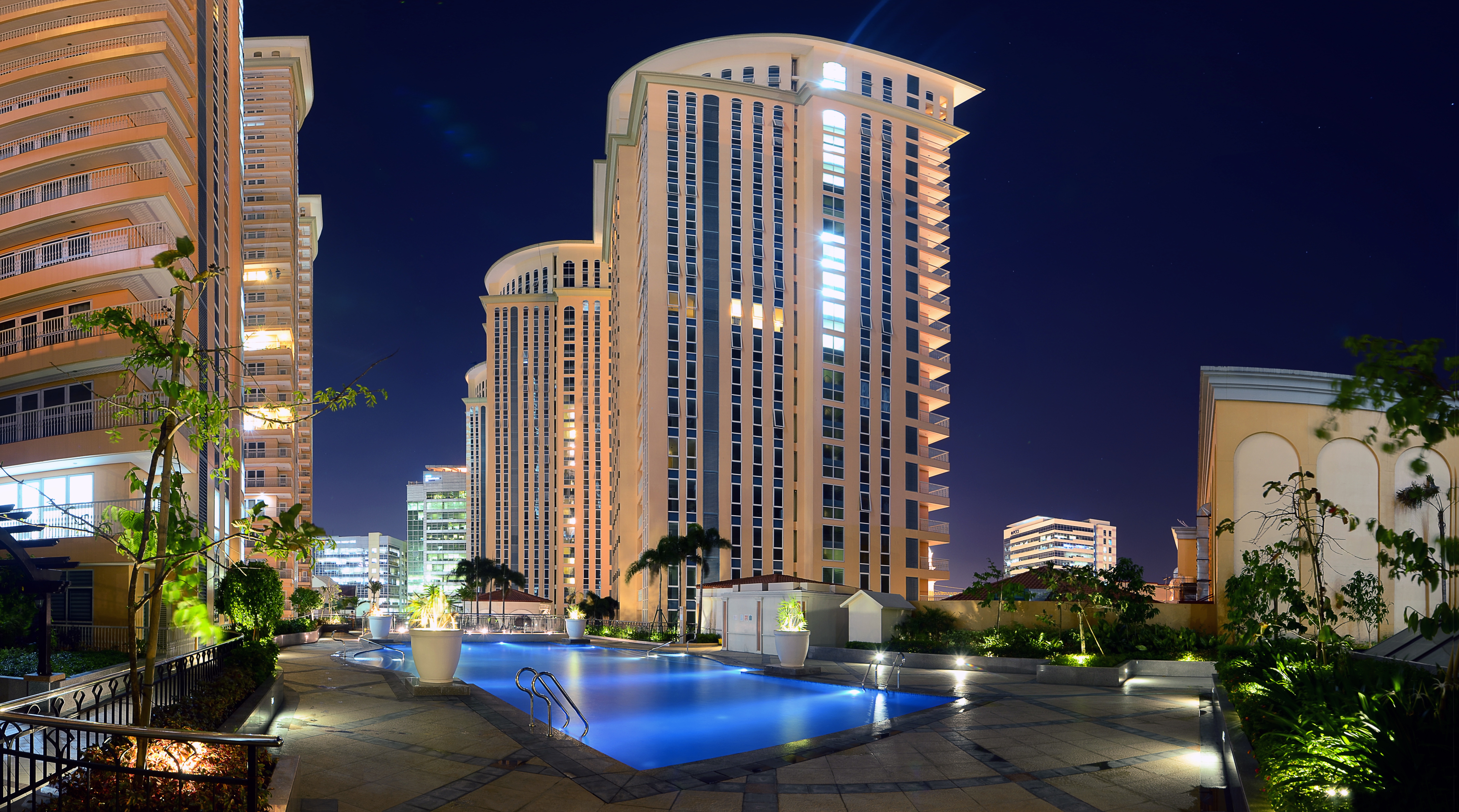
Pre-selling changes this calculus further, because the down payment itself is paid in installments during construction rather than in a single lump sum — which means a buyer effectively gets years of "renting" a lower monthly commitment before the full loan balance and amortization begin at turnover. The full mechanics of that structure are in the pre-selling condos in Manila guide.
There is a second lever worth naming alongside down payment size: loan term length. Stretching a Salcedo unit's financing from 20 to 25 years lowers the monthly amortization further, which narrows the gap against rent in the near term — but it also means interest dominates a larger share of each payment for longer, slowing how quickly real equity builds. The net effect on break-even is usually modest and slightly negative, since the near-term cash-flow relief is offset by slower equity accumulation, which is why this guide's worked examples hold the term constant at 20 years rather than treating term length as a lever with the same upside as a bigger down payment.
The practical takeaway: a buyer who can stretch to a 25–30% down payment meaningfully shortens their break-even timeline versus the minimum-down-payment path, and that difference compounds every year the unit is held afterward.
What Do Three Real Makati Rent-vs-Buy Profiles Look Like?
Numbers in the abstract obscure the decision more than they clarify it. Three calibrated profiles make the math concrete.
Profile A — Young professional, Poblacion studio, 3-year horizon. Renting a ₱35,000/month Poblacion studio costs roughly ₱1.26M over three years, no financing exposure, full flexibility to relocate. Buying the same unit (~₱4.2M) with a 15% down payment produces a break-even years past this buyer's three-year horizon — renting is the clearly better math here, regardless of district.
Profile B — Mid-career expat, Salcedo 1BR, 8-year horizon. Renting at ₱55,000/month over eight years costs roughly ₱5.28M with zero equity built. Buying the ₱9.2M unit above, with a 20% down payment, lands close to this buyer's break-even point — meaning eight years is roughly the point where this specific profile's numbers turn favorable toward ownership, assuming Salcedo's historical appreciation rate holds.
Profile C — Dual-income couple, Rockwell 2BR, 15-year horizon. Renting a Rockwell 2-bedroom at ₱150,000/month over fifteen years totals roughly ₱27M with no equity. Buying at Rockwell's premium price tier, even with an 11-year break-even, leaves four years of "ownership ahead" by year fifteen — a horizon long enough that even Rockwell's slower break-even resolves clearly in favor of buying.
A fourth, shorter profile is worth adding because it is the most common real-world case this guide receives questions about. Profile D — OFW investor, Salcedo 1BR, rented out immediately. An OFW buying the same ₱9.2M Salcedo unit as Profile B, but renting it out at market rate (₱55,000/month) rather than living in it, effectively uses rental income to offset most of the ₱65,000–₱68,000 monthly ownership cost calculated earlier — narrowing the buyer's true out-of-pocket exposure to roughly ₱10,000–₱13,000/month. This materially shortens the personal-cash-flow break-even, though it does not change the underlying asset-level break-even math, since the same rental income the owner collects is money a tenant would otherwise be paying that owner regardless of who lives there. OFWs weighing this exact structure should also read the payment mechanics in the OFW guide to buying a Manila condo from abroad, since remittance-funded down payments change the early-years cash-flow picture further.
What these four profiles share is more instructive than their differences: in every case, the deciding variable is not "is Makati worth it" in the abstract — it is the specific combination of district, financing structure, and the buyer's own horizon or rental strategy. A guide that gives one universal answer to "rent or buy in Makati" is skipping the part of the analysis that actually determines the outcome for any individual reader.
The pattern across all three profiles: horizon length matters as much as district. A short horizon favors renting almost everywhere in Makati; a long horizon favors buying almost everywhere, with the district mainly determining how long "long enough" actually is.
Does a BGC-Area Alternative Break Even Faster Than Makati?
Often, yes, for a first purchase specifically — and it is the comparison this guide would be incomplete without. A pre-selling unit at Uptown Modern in Uptown Bonifacio, BGC enters at a lower relative per-sqm price than Makati's CBD-core villages while offering newer construction, which shortens the financing-cost gap against comparable BGC rent faster than Salcedo or Rockwell's math allows. The trade, as covered in the fuller Makati vs BGC comparison, is that Makati's Poblacion and Salcedo carry today's MRT-3 rail access and decades of established demand, which BGC's newer towers do not yet match. Break-even speed is one input to this decision, not the only one — see living in BGC 2026 for the fuller lifestyle picture.
Why does a newer-build BGC-area unit narrow the ownership-vs-rent gap faster in the first place? Two structural reasons. First, a newer tower's association dues per square meter tend to run at or below Makati's older CBD-core buildings, since modern mechanical systems and structures cost less to maintain per unit in their early years. Second, a pre-selling entry price in a newly launched precinct like Uptown Bonifacio typically sits below what an equally-sized unit costs in an established, supply-constrained village like Salcedo — not because the BGC-area unit is lower quality, but because Salcedo's decades of sustained demand have already priced in a scarcity premium that a newer precinct has not yet accumulated.
The honest framing: a buyer optimizing purely for break-even speed on a first purchase should run the BGC-area numbers alongside Makati's before committing. A buyer anchored to Makati specifically — by job, family, or genuine preference — should treat the district's slower break-even as the fair price of that anchor, not as a reason to avoid buying altogether.
So, Should You Rent or Buy in Makati Right Now?
The honest answer depends entirely on horizon and district, not on a universal rule. Under a five-year horizon, renting wins the math in every Makati district covered here. A five-to-eight-year horizon favors buying in Poblacion, is a close call in Salcedo and Legazpi, and still favors renting in Rockwell. Past eight years, buying wins in Poblacion and Salcedo/Legazpi decisively, and Rockwell catches up by year eleven or beyond. None of this accounts for a buyer's non-financial reasons to own — stability, control over the space, or simply wanting a home rather than a lease — which are legitimate and this guide does not discount them, only isolates the pure financial comparison so a buyer can weigh both consciously.
One last practical note for anyone treating this guide as a starting worksheet rather than a final answer: every number above is sensitive to the specific unit, the specific building's dues structure, and the specific rate a buyer actually qualifies for — a Pag-IBIG-eligible buyer, a bank-financed buyer, and an in-house-financed buyer will each produce a meaningfully different break-even year on the identical unit. The district-level ranges in this guide are the right starting frame; the final number for any individual buyer only comes from running their actual financing quote against their actual target unit's actual rent comparable, not from a generic table alone.
Tell us your target district, budget, and expected time horizon, and we'll help you run the real numbers for your specific situation — including how a live Uptown Bonifacio pre-sell compares against the Makati math above.
About the Author
MSC Editorial is the in-house editorial team of Manila Skyline Condos. The team researches Philippine condo financing, ownership costs, and neighborhoods using primary developer, brokerage, and financing sources, tracking Makati rent and purchase data and live condo inventory across the Philippines.
A Quick, Honest Disclaimer
This guide is general information, not financial or investment advice. All rent, purchase price, financing, and break-even figures are 2026 modeled estimates using representative financing assumptions (20% down, 20-year term, 7% rate unless stated) and should not be treated as a quote or guarantee for any specific unit. Actual break-even timelines depend on individual financing terms, market movement, and the specific building. Confirm current figures with a licensed Philippine real estate broker and a bank or Pag-IBIG loan officer before deciding. Contact us for a referral to appropriate financing resources.
Frequently Asked Questions
When does buying break even against renting in Makati?
It varies by district: roughly year six to eight in Poblacion, year eight to eleven in Salcedo and Legazpi, and year eleven or later in Rockwell, using representative 2026 rent, price, and financing assumptions. A larger down payment or stronger-than-average appreciation can shorten these timelines.
Is it cheaper to rent or buy in Makati?
Under a five-year horizon, renting is cheaper in every Makati district in this guide. Past eight to eleven years, depending on district, buying is typically cheaper, once equity built and historical appreciation are factored against rent paid. The crossover point depends heavily on down payment size and financing rate.
Which Makati district breaks even fastest for buyers?
Poblacion, typically around year six to eight, because its lower per-sqm entry price (₱150,000–₱220,000) keeps the financing-cost gap against rent narrower than Salcedo, Legazpi, or Rockwell from the start.
How does down payment size affect the Makati break-even point?
Significantly. A larger down payment reduces the financed loan balance and monthly amortization, narrowing the gap against comparable rent and pulling break-even earlier. On a ₱9.2M Salcedo unit, moving from a 10% to a 30% down payment can shift the monthly amortization from roughly ₱64,000 to ₱50,000, meaningfully shortening the timeline.
Is Rockwell a good buy for someone planning to stay long-term?
Yes, for a horizon past eleven to fifteen years. Rockwell's premium per-sqm pricing produces the slowest break-even among Makati districts, but a long-term owner still comes out ahead once the loan balance shrinks and Rockwell's historical appreciation (roughly 18% over the most recent two-year window) compounds.
Should I rent in Makati if I'm only staying three years?
Yes. Under a five-year horizon, renting is the better financial choice in every Makati district covered here — the transaction costs and financing-heavy early years of ownership rarely pay back that quickly, regardless of district or down payment size.
Does a BGC-area condo break even faster than a Makati one?
Often, yes, for a first purchase — a pre-selling unit like Uptown Modern in Uptown Bonifacio enters at a lower relative per-sqm price than Makati's CBD-core villages, narrowing the financing-cost gap against comparable BGC rent faster. Makati's Poblacion and Salcedo carry today's MRT-3 access and established demand as an offsetting factor. The full comparison is in the Makati vs BGC guide.
What financing rate does this break-even math assume?
The worked examples in this guide use a representative 7% annual rate over a 20-year term with a 20% down payment unless stated otherwise, based on 2026 market conditions. Actual rates vary by bank, Pag-IBIG eligibility, and borrower profile — confirm current rates with a loan officer before modeling your own numbers.
Does pre-selling change the rent-vs-buy math in Makati?
Yes. Pre-selling spreads the down payment across construction rather than requiring it upfront, effectively giving a buyer a lower monthly commitment for the first two to four years before the full loan and amortization begin at turnover — which can make the early-ownership years look more like renting than a fully financed purchase.
Are association dues included in this break-even calculation?
Yes. Association dues (typically ₱100–₱200+ per sqm per month in Makati CBD buildings) are added to the ownership side of the comparison alongside amortization and property tax, since a renter does not pay this cost directly. Excluding dues would understate ownership's true monthly cost and artificially shorten break-even.
Sources
Rent, price, and break-even figures in this guide are 2026 market estimates and modeled projections using representative financing assumptions, cross-referenced against Manila Skyline Condos' living-in-makati-2026 and cost-of-living-makati-2026 pillar content.
- Makati rent and buy price ranges (2026) — Lamudi Makati condo rent: https://www.lamudi.com.ph/rent/metro-manila/makati/condo/ ; Lamudi Makati condo buy: https://www.lamudi.com.ph/buy/metro-manila/makati/condo/ ; Hoppler Rockwell listings: https://www.hoppler.com.ph/condominiums-for-sale/makati/rockwell-center
- Makati appreciation data (Salcedo/Legazpi 5-8%/yr, Rockwell ~18% two-year) — Franchise Manila 2026 Makati Condo Rental Yield Report: https://franchisemanila.com/2025/12/2026-makati-condo-rental-yield-report-salcedo-legazpi-rockwell/
- Association dues ranges — Lamudi and Hoppler building disclosures, June 2026; MakatiApartments.com: https://makatiapartments.com/
- Break-even modeling methodology — standard amortization and net-present-cost framework; representative 20% down / 20-year / 7% assumption applied for illustration, not a specific bank quote
- BGC-area live inventory referenced (Uptown Modern) — Manila Skyline Condos internal VERIFIED-BUILDING-SPECS.md, cross-checked against Megaworld sources, 2026-06-07
- Property page (link target, verified location, June 2026): Uptown Modern — Uptown Bonifacio, BGC, Taguig (Megaworld): https://manilaskylinecondos.com/properties/uptown-modern
